Secure IT Infrastructure: Best Guide for Remote Teams | GoCo
Learn how secure IT infrastructure protects remote and hybrid teams with IAM, MFA, endpoint security, and zero-trust strategies. Start today 🔐
How to Build a Secure I.T. Infrastructure for Remote and Hybrid Teams
Your office is no longer your perimeter. In remote and hybrid environments, every employee’s laptop, home Wi-Fi network, and mobile device becomes part of your company’s infrastructure. The traditional model, where security was concentrated inside a physical office, no longer applies. If your workforce is distributed, your Secure I.T. Infrastructure must be distributed as well.
The question is not whether remote work increases risk. It does.
The real question is whether your I.T. and security model has evolved with it.
This article outlines the key components required to build a secure, scalable I.T. infrastructure for remote and hybrid teams, without slowing down productivity.
Start with Identity, Not Location
In a remote environment, identity becomes the new perimeter. You can no longer rely on network-based trust. Instead, access must be tied to:
- Verified users
- Authenticated devices
- Controlled permissions
A secure I.T. infrastructure begins with strong Identity and Access Management (IAM). This includes:
- Unique user accounts (no shared credentials)
- Role-based access control
- Principle of least privilege
- Single Sign-On (SSO)
Every user should have access only to what they need—and nothing more.
Enforce Multi-Factor Authentication (MFA) Everywhere
Passwords alone are no longer sufficient. For remote and hybrid teams, Multi-Factor Authentication should be mandatory across:
- Email systems
- Cloud applications
- VPN access
- Administrative accounts
MFA significantly reduces the risk of credential compromise, especially in environments where employees connect from multiple locations and devices.
Security must assume credentials will eventually be targeted. MFA ensures they are not easily exploited.
Secure the Endpoint: Every Device Is an Entry Point
In distributed teams, endpoints are the new attack surface. A Secure I.T. Infrastructure must include:
- Company-managed devices whenever possible
- Full-disk encryption
- Endpoint Detection and Response (EDR)
- Patch management automation
- Remote device monitoring
Unmanaged devices introduce significant risk. Even if access is controlled, an insecure endpoint can expose data or act as a pivot point for attackers. Endpoint security is not optional in remote environments; it is foundational.
Standardize Onboarding and Offboarding
Remote hiring increases operational speed. Remember that without structure, it also increases risk. Secure onboarding should include:
- Pre-configured devices
- Enforced security policies
- Documented access provisioning
- Mandatory MFA activation
Secure offboarding should include:
- Immediate access revocation
- Device recovery or remote wipe
- Token and API key rotation
- Audit of privileged permissions
Remote teams amplify the importance of lifecycle management. A delayed offboarding process in a distributed environment creates unnecessary exposure.
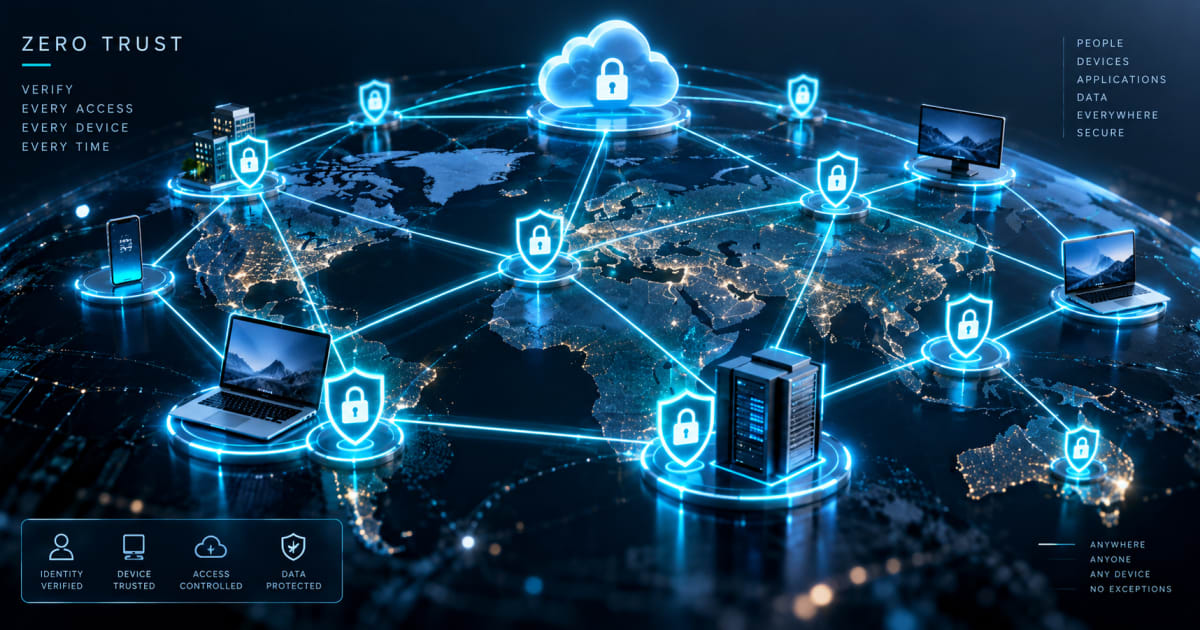
Implement Zero-Trust Principles
Zero-trust security operates under one assumption: No user, device, or network is trusted by default.
For remote and hybrid teams, this means:
- Continuous authentication
- Device verification before access
- Network segmentation
- Monitoring unusual activity
Zero-trust is not a single product. It is an architectural approach that aligns naturally with distributed workforces. A Secure I.T. Infrastructure is built on verification, not assumption.
Centralize Visibility and Monitoring
Visibility becomes more complex in remote setups. Without centralized monitoring, organizations struggle to:
- Detect anomalies
- Identify unauthorized access
- Track configuration drift
- Respond quickly to incidents
A secure model includes the following: Centralized logging, alerting systems, activity monitoring across cloud platforms, and Regular access reviews. Security is not just prevention. It is detection and response.
Protect Data, Not Just Devices
Data in remote environments moves constantly:
- Between cloud services
- Across endpoints
- Through collaboration tools
Data protection should include:
- Encryption in transit and at rest
- Access-based data restrictions
- Backup and recovery planning
- Clear data ownership policies
A Secure I.T. Infrastructure protects information regardless of where it is accessed.
Align I.T. with Security and Business Strategy
Security cannot exist in isolation from business operations. Remote and hybrid models often evolve quickly. Here is what happens when you don’t have a strategic alignment:
- New tools are introduced without risk assessment
- Shadow I.T. increases
- Compliance requirements are overlooked
To build a Secure I.T.Infrastructure you require:
- Defined ownership
- Structured project management
- Security embedded into decision-making
Technology decisions need to support both productivity and protection.
Common Gaps in Remote I.T. Environments
Growing companies frequently overlook:
- Home network risks
- Inconsistent device management
- Informal collaboration tools
- Lack of documented security policies
These gaps rarely cause immediate disruption, but they accumulate over time. Security should be intentional, not accidental.
The GoCo Perspective: Structure Enables Secure IT Infrastructure
At GoCo, we approach remote I.T. infrastructure as both a technical and operational challenge. A secure distributed model requires:
- Clear ownership
- Standardized processes
- Proactive risk management
- Integrated I.T. and security execution
Technology alone does not create security. Structure does. We all know that remote and hybrid work are permanent parts of modern business, so infrastructure must reflect that reality.
The office may be optional. Security is not.
Building a Secure I.T. Infrastructure for remote and hybrid teams means rethinking trust, identity, endpoints, and visibility.
Companies that invest in structured, security-first IT today reduce risk tomorrow—and scale with confidence.
Distributed work is not the threat. Unstructured infrastructure is.
With us, You’re in Good Company.

Technology decisions shouldn't be based on trends; they should support better business outcomes.
Explore our latest LinkedIn articles, where we share practical insights on Managed IT Services, cybersecurity, governance, operational excellence, and the strategies helping businesses reduce risk and scale with confidence.
Because better decisions start with better understanding.
Good Company IT
GoCo
You are in Good Company