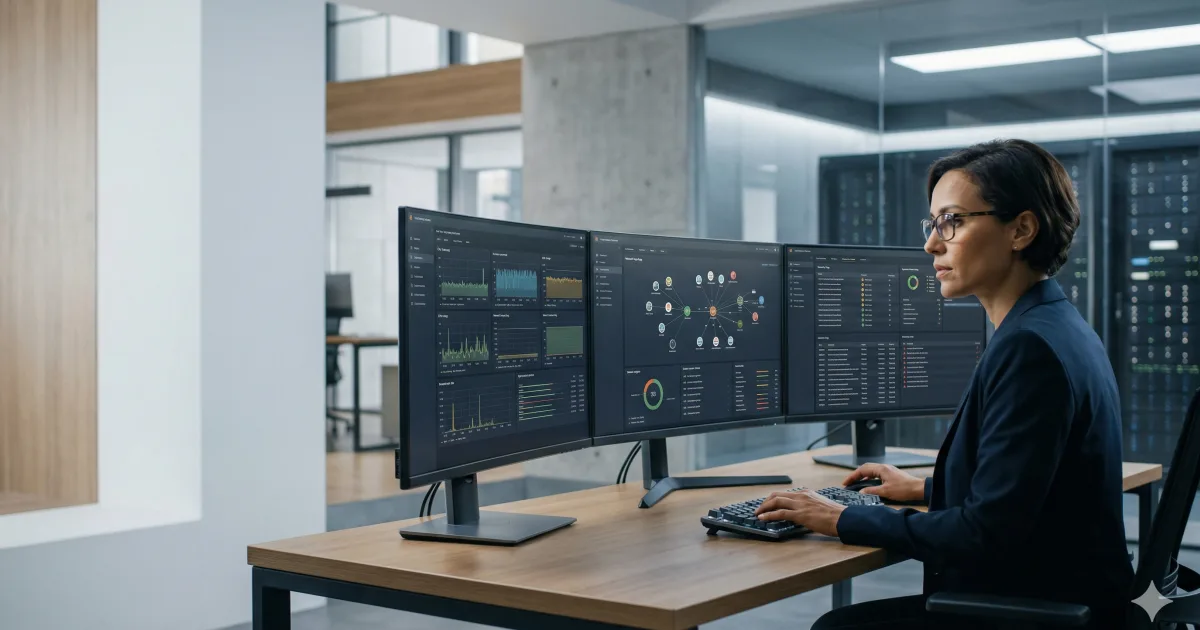
IT Monitoring Explained: How Proactive Monitoring Prevents Downtime and Data Loss
IT Monitoring helps prevent downtime and data loss. Learn proactive monitoring strategies to protect your IT systems. Discover more ⚙️
What I.T. Monitoring Actually Means
I.T. Monitoring is the continuous observation of systems, devices, networks, and applications to detect issues before they impact operations. It provides visibility into:
- System performance
- Device health
- Network activity
- Security events
The goal is simple: Identify problems early — before they become disruptions.
Reactive vs. Proactive I.T. Environments
In many organizations, I.T. operates reactively:
- An issue occurs
- A user reports it
- The team investigates and resolves it
This model depends on failure.
Proactive I.T. Monitoring changes that dynamic:
- Systems generate alerts
- Anomalies are detected in real time
- Issues are addressed before users notice them
The difference is not just speed. It’s control.
How Proactive I.T. Monitoring Prevents Downtime
Downtime rarely happens without warning. There are usually signals:
- Increased CPU usage
- Memory leaks
- Network latency
- Failed login attempts
- Unusual system behavior
Without monitoring, these signals are invisible. With I.T. Monitoring, they become actionable.
For example:
- A server reaching capacity can be addressed before it crashes
- A failing device can be replaced before it stops working
- A misconfigured system can be corrected before it disrupts operations
Monitoring turns potential failures into manageable events.
How I.T. Monitoring Reduces Data Loss
Data loss is often the result of:
- System failures
- Unauthorized access
- Lack of backups
- Delayed response to incidents
I.T. Monitoring plays a critical role in preventing these scenarios by:
- Tracking backup status and failures
- Detecting unusual access patterns
- Identifying system anomalies that could compromise data integrity
- Alerting teams to issues in real time
The key is timing. The sooner an issue is detected, the lower the impact.
Key Components of Effective I.T. Monitoring
1. Endpoint Monitoring
Every device connected to your environment represents a potential risk. Monitoring includes:
- Device health
- Patch status
- Security posture
Unmanaged endpoints are one of the most common sources of failure.
2. Network Monitoring
Network performance affects everything. Monitoring focuses on:
- Connectivity
- Latency
- Traffic patterns
Issues at this level can impact multiple systems simultaneously.
3. Security Monitoring
Not all issues are operational. Some are threats.
Monitoring helps detect:
- Suspicious login attempts
- Unauthorized access
- Anomalous behavior
This is where I.T. and security intersect.
4. Alerting and Response
Monitoring without response is incomplete. Effective systems include:
- Real-time alerts
- Defined escalation paths
- Clear ownership of incidents
Detection is only valuable if action follows.
Common Mistakes in I.T. Monitoring
- Monitoring too little (limited visibility)
- Monitoring too much (alert fatigue)
- Ignoring alerts or lacking response processes
- Treating monitoring as a tool, not a system
Effective I.T. Monitoring requires balance, structure, and clear processes.
Why Monitoring Is Critical for Growing Companies
As organizations grow, complexity increases:
- More users
- More systems
- More integrations
Each new component adds potential points of failure. Without I.T. Monitoring, visibility decreases as complexity increases.
This creates an environment where issues are discovered too late. Monitoring ensures that growth does not compromise stability.
Conclusion:
I.T. Monitoring is not about watching systems. It’s about understanding them.
It provides the visibility needed to:
- Prevent downtime
- Protect data
- Maintain operational continuity
In modern I.T. environments, the question is no longer: “Can we fix issues when they happen?”
It becomes: “Can we detect them before they impact the business?”
Because the most effective I.T. environments are not the ones that respond quickly. They are the ones who rarely need to respond at all.
Remember that with CoCo, You’re in Good Company.
Explore our latest LinkedIn articles, where we share practical insights on Managed I.T. Services, cybersecurity, governance, operational excellence, and the strategies helping businesses reduce risk and scale with confidence.
Because better decisions start with better understanding.
Good Company I.T.
GoCo
You are in Good Company