Supply Chain Attacks: Best Prevention Guide | GoCo
Supply Chain Attacks threaten every business. Strengthen your cybersecurity and supply chain security. Learn more today 🔒🚀
What Is a Supply Chain Attack?
A Supply Chain Attack happens when cybercriminals infiltrate your systems through a third-party vendor, supplier, or service provider that your business relies on.
Instead of attacking you directly, they compromise software updates, login portals, or integrations from trusted partners—allowing them to move through your environment undetected.
Think of it as poisoning the well instead of attacking each drinker individually.
Common Entry Points in Supply Chain Attacks
- Software updates: Hackers inject malicious code into legitimate updates (like the infamous SolarWinds breach).
- Third-party integrations: Weak APIs or poorly secured vendor connections create open doors.
- Hardware tampering: Devices with pre-installed malware introduced during manufacturing.
- Compromised credentials: Vendors or contractors with overprivileged access.
- Managed service providers (MSPs): Attackers compromise IT providers to reach multiple downstream clients.
The scary part? You might not even notice until it’s too late—because the attack often originates from a trusted source.
Why Small Businesses Are a Growing Target
It’s a myth that supply chain attacks only happen to global enterprises. In reality, small and midsize businesses (SMBs) are now on the front lines.
-
You’re an easier entry point: Hackers see SMBs as the “low-hanging fruit.” Vendors or small partners often have fewer security resources, but they connect to large enterprise networks—making them ideal targets.
-
Shared software = shared risk: If your business uses common tools like Microsoft 365, QuickBooks Online, or Slack, you share risk with thousands of others. A single vulnerability in a popular platform can cascade across users globally.
-
Limited vendor oversight: Many SMBs don’t have a formal Vendor Risk Management (VRM) program. You might trust that your payroll app or IT provider has security handled—but without auditing them, you’re taking their word for it.
-
Outsourced I.T. and cloud dependencies: Reliance on MSPs and SaaS vendors is at an all-time high. While this drives efficiency, it also means your data lives across multiple environments you don’t control.
According to Verizon’s 2024 Data Breach Report, nearly 62% of breaches involve third-party components—and that number is still climbing.
The Anatomy of a Supply Chain Attack
To truly understand the threat, let’s look at how these attacks unfold.
-
Step 1: Infiltration: Hackers identify a weak link in your supply chain—often a smaller vendor or contractor. They breach that organization’s system, inject malicious code, or steal credentials.
-
Step 2: Propagation: Once inside, they use legitimate vendor channels (software updates, shared access, or API connections)to spread to your network.
-
Step 3: Execution: The attacker leverages their position to steal sensitive data, install ransomware, or disrupt operations.
-
Step 4: Persistence: The most sophisticated attackers don’t just hit and run—they stay. Hidden in your network, they monitor communications, exfiltrate data slowly, and wait for the perfect moment to strike again.
- In other words: the very systems you trust most become the ones that betray you.
The Cost of a Supply Chain Attack
Beyond the initial chaos, the impact of a supply chain attack can last years.
- Financial losses: Remediation, regulatory fines, and client compensation.
- Downtime: Disrupted services and productivity.
- Reputation damage: Loss of customer trust and vendor confidence.
- Compliance fallout: Violations of SOC 2, ISO 27001, HIPAA, or GDPR standards.
According to IBM’s Cost of a Data Breach Report 2024, supply chain-related breaches averaged $4.76 million, higher than nearly every other breach type.
For small businesses, even a fraction of that cost can be catastrophic.
How to Identify Weak Links in Your Supply Chain
You can’t protect what you don’t see. Here’s how to start identifying your risk exposure:
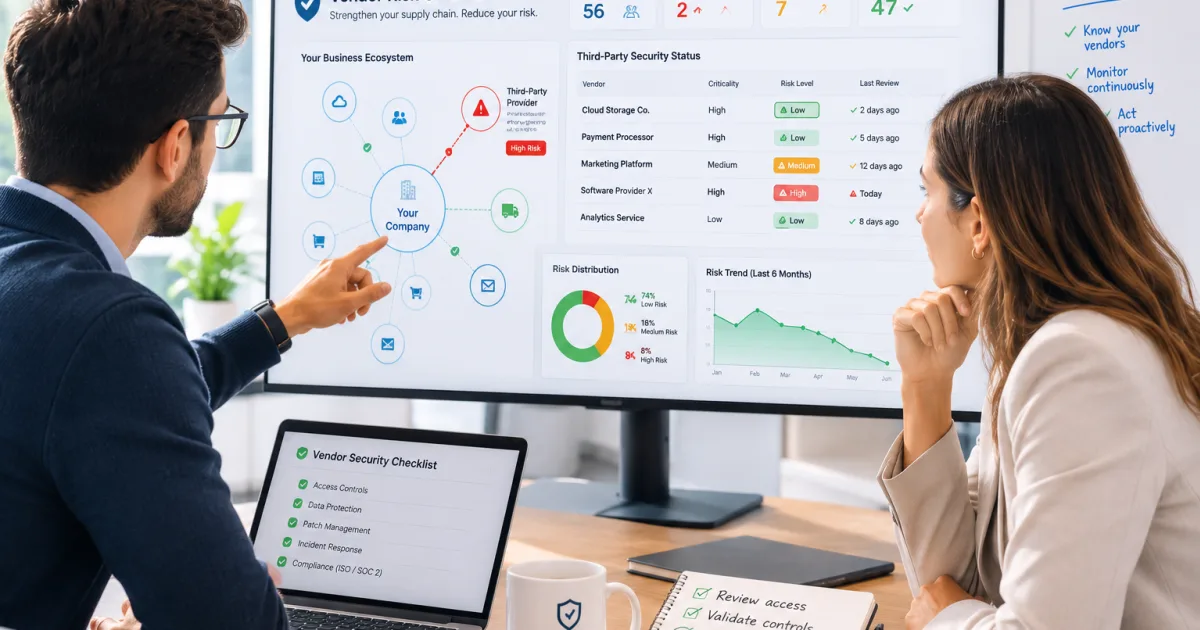
- Map Your Vendor Ecosystem
List every external provider that touches your data, systems, or processes.
This includes:
- SaaS tools (CRM, ERP, HR platforms)
- Payment processors
- Cloud providers
- MSPs and I.T. contractors
- Marketing or data analytics vendors
- Evaluate Their Security Posture
Request evidence of compliance: SOC 2, ISO 27001, or relevant certifications.
Ask:
- How do they encrypt data?
- Do they perform regular penetration testing?
- What’s their incident response process?
- Review Access Privileges
Who inside your vendors can access your environment?
When the answer is “everyone,” it’s time to implement least privilege and zero-trust principles.
- Monitor Vendor Changes
A vendor acquisition, new subcontractor, or API update can introduce new risk.
Security due diligence shouldn’t be a one-time task—it’s ongoing.
How to Protect Your Business from Supply Chain Attacks
- Step 1: Adopt a Zero-Trust Framework
Trust no one. Verify everything.
In a Zero-Trust Architecture (ZTA), every user, device, and application must prove its legitimacy before gaining access—whether internal or external.
- Require multi-factor authentication (MFA) for all vendor accounts.
- Segment your network to isolate systems.
- Continuously monitor traffic between your systems and vendors.
- Step 2: Secure Your Endpoints
Even if the initial breach happens elsewhere, your endpoints (laptops, servers, IoT devices) are where the attack lands.
- Deploy Endpoint Detection and Response (EDR) solutions.
- Keep systems updated and patched automatically.
- Implement device management for remote and hybrid employees.
- Step 3: Implement Continuous Monitoring
Use Security Information and Event Management (SIEM) or Extended Detection and Response (XDR) tools to detect anomalies across your environment.
Automate alerts for suspicious vendor activity.
- Step 4: Vet and Limit Vendor Access
Every external connection should follow the Principle of Least Privilege.
Set time-bound, role-based access. Disable credentials immediately when contracts end.
- Step 5: Back Up Critical Systems
If a supply chain attack deploys ransomware, backups are your lifeline.
Use immutable, encrypted, offsite backups—and test them regularly.
- Step 6: Formalize a Vendor Risk Management (VRM) Program
This doesn’t need to be complex. Start simple:
- Create a vendor onboarding checklist.
- Rate vendors based on risk exposure.
- Conduct annual reviews.
MSPs like GoCo can automate much of this process, giving you real-time visibility into vendor health.
- Step 7: Train Your Team
Human error is still the weakest link.
Educate staff about phishing, malicious links, and social engineering—especially those with vendor communication responsibilities.
Compliance and Supply Chain Security
Regulatory bodies now expect businesses to manage third-party risk as part of their cybersecurity posture.
Frameworks like:
- SOC 2 Type II: Evaluates third-party vendor controls.
- ISO 27036: Focuses on supply chain information security.
- NIST SP 800-161: Guides organizations on managing cybersecurity in the supply chain.
Failing to comply can result in not just financial penalties, but also lost partnerships. Many enterprise clients now require vendors to prove supply chain security maturity before signing contracts.
If you’re in a B2B environment, this can make or break deals.
How Managed Security Services Strengthen Supply Chain Resilience
For many SMBs, managing these layers internally isn’t realistic. That’s where a Managed Service Provider (MSP) or Managed Security Service Provider (MSSP) comes in.
At GoCo, we specialize in helping businesses:
- Audit and secure third-party connections.
- Implement Zero-Trust security frameworks.
- Align configurations with compliance standards (SOC 2, ISO 27001, HIPAA).
- Respond rapidly to threats detected through integrated SIEM systems.
By outsourcing security operations, you gain enterprise-level protection without the overhead of maintaining an internal I.T. security team.
What to Do Right Now
You don’t need to overhaul your entire infrastructure overnight. Start small—start smart.
Here’s your action checklist for immediate impact:
- Identify all vendors and software that touch your business data
- Enable MFA for every external account and integration
- Segment your network to isolate high-risk connections
- Review and update vendor contracts for security obligations
- Back up critical systems
- Schedule a third-party security audit
Every step reduces your exposure—and increases your resilience.
In a Connected World, Security Is Shared
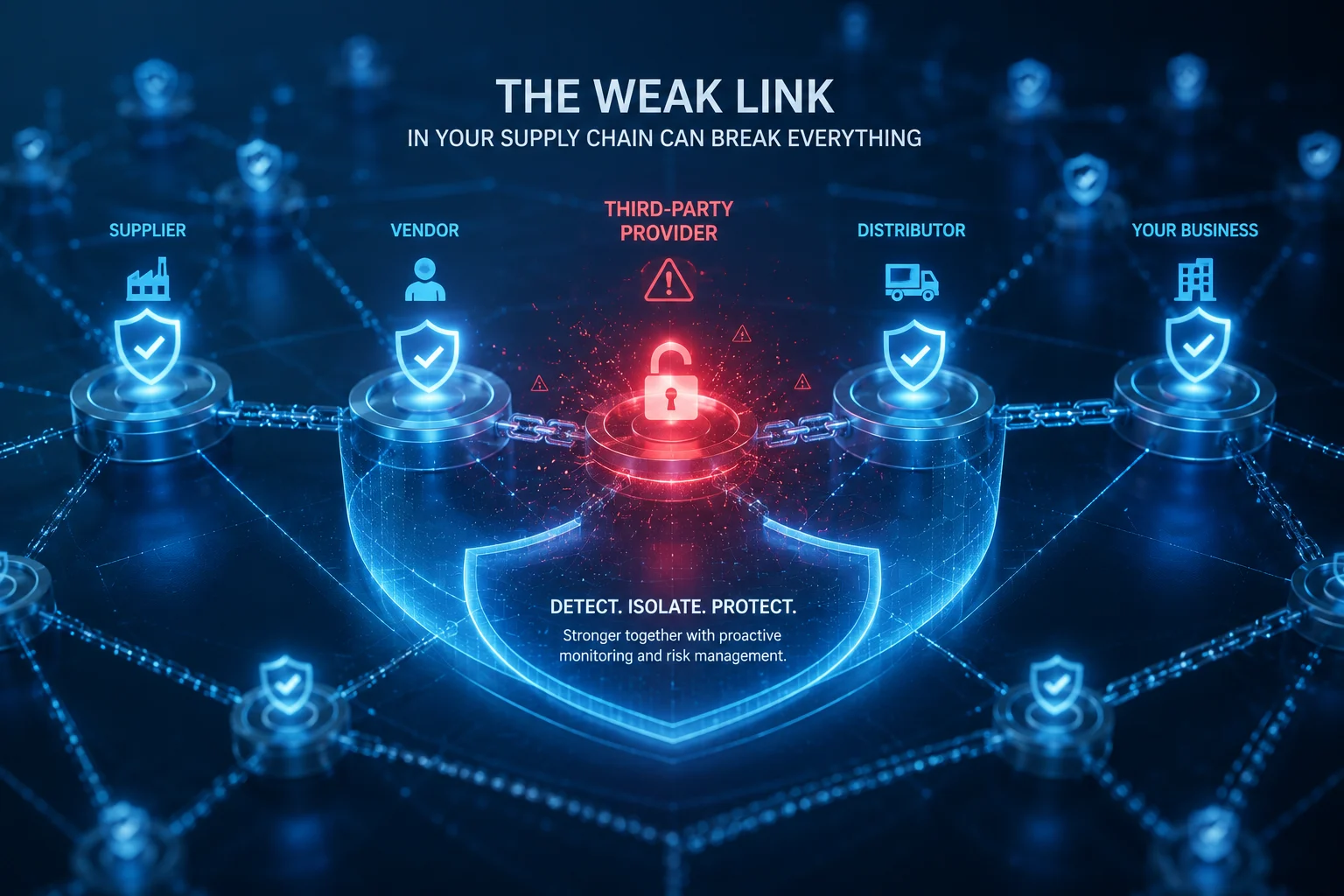
Supply chain attacks remind us that your business is only as secure as the weakest link in your network**.**
But here’s the good news: You don’t have to control everything; you just must manage it intelligently.
Building resilience means understanding your dependencies, securing your connections, and partnering with the right experts**.**
In cybersecurity, the question isn’t if someone in your supply chain will be targeted—it’s when.
The businesses that thrive will be those prepared before it happens.
Ready to Strengthen Your Supply Chain Security?
At GoCo, we help SMBs audit, monitor, and secure their vendor ecosystems, reducing risk while maintaining operational efficiency.
Technology decisions shouldn't be based on trends; they should support better business outcomes.
Explore our latest LinkedIn articles, where we share practical insights on Managed IT Services, cybersecurity, governance, operational excellence, and the strategies helping businesses reduce risk and scale with confidence.
Because better decisions start with better understanding.
Good Company IT | GoCo
You are in Good Company