Endpoint Security: Best Onboarding & Offboarding Tips | GoCo
Learn how Endpoint Security secures employee onboarding and offboarding. Protect devices, access, and identities as you scale. Start today 🛡️
How to Secure Employee Onboarding and Offboarding in Growing Companies
The fastest way to weaken your security posture isn’t a cyberattack.
It’s a rushed onboarding. Or a forgotten offboarding.
As companies grow, hiring accelerates, roles evolve, and teams become distributed. At that speed, Endpoint Security often becomes reactive rather than intentional. Devices are shipped quickly. Access is granted informally. Offboarding gets delayed. And suddenly, former employees or unmanaged laptops still have access to critical systems.
This article breaks down how to properly secure onboarding and offboarding, why Endpoint Security is the foundation of both, and how growing companies can protect themselves without slowing operations.
Why Onboarding and Offboarding Are High-Risk Moments
Every employee lifecycle change creates risk.
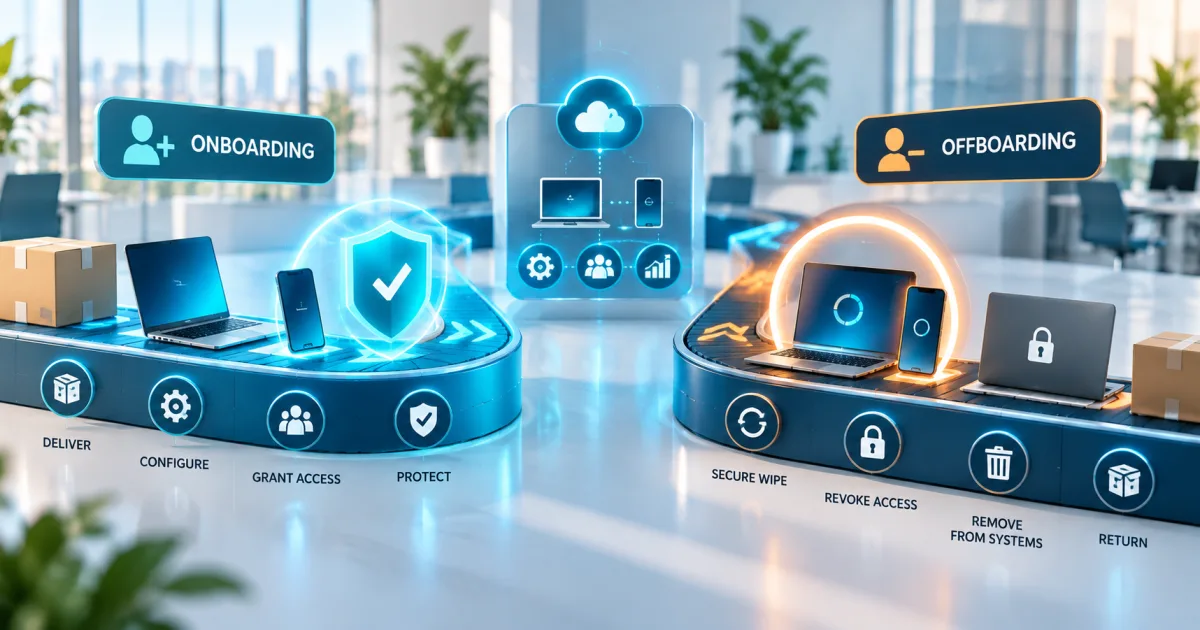
During onboarding:
- New devices enter your environment
- New identities are created
- Access is granted across multiple systems
During offboarding:
- Access must be revoked
- Devices must be secured or recovered
- Credentials must be invalidated
When these steps are rushed or undocumented, companies unintentionally leave doors open. Most security incidents tied to insiders, intentional or not, trace back to poorly managed endpoints and access controls.
This is why Endpoint Security must be built into the onboarding and offboarding process from day one.
Endpoint Security: The Foundation of Secure Workforce Management
Endpoint Security refers to protecting the devices that access your systems:
- Laptops
- Desktops
- Mobile devices
- Tablets
- Remote endpoints
In modern companies, the endpoint is the perimeter.
A secure onboarding or offboarding process depends on:
- Device control
- Identity verification
- Access management
- Visibility into activity
Without these elements, even the best I.T. tools can’t protect you.
Secure Employee Onboarding: What Growing Companies Must Get Right
Onboarding is not just about productivity. It’s about controlled access.
1. Provision Devices Before Day One
Every employee device should be:
- Company-owned or formally approved
- Enrolled in endpoint management tools
- Configured with security baselines
- Encrypted by default
Shipping a laptop without device management is equivalent to handing over company access without oversight.
2. Enforce Identity and Access Management (IAM)
Access should never be granted manually or informally.
A secure onboarding process includes:
- Unique user accounts (no shared credentials)
- Role-based access control
- Least-privilege permissions
- Single Sign-On (SSO) where possible
Endpoint Security and IAM work together. If identity isn’t controlled, the endpoint becomes a liability.
3. Require Multi-Factor Authentication (MFA)
Passwords alone are no longer sufficient.
MFA should be mandatory for:
- Cloud platforms
- VPNs
- Administrative tools
This single step significantly reduces the impact of credential compromise during onboarding.
4. Configure Endpoint Protection and Monitoring
Before an employee logs in for the first time, the device should have:
- Endpoint Detection and Response (EDR)
- Antivirus and malware protection
- Patch management enabled
- Logging and monitoring active
Endpoint Security is not something you “add later.” It must be part of the initial configuration.
5. Document the Onboarding Process
Documentation is often skipped, but it is critical for:
- Consistency
- Audits
- Security reviews
- Scaling safely
Clear onboarding checklists ensure no step is missed as hiring volume increases.
Secure Offboarding: Where Most Companies Fall Short
Offboarding is often more dangerous than onboarding. Why? Because it happens fast, emotionally, or unexpectedly.
1. Revoke Access Immediately: Access removal should be:
- Automated where possible
- Triggered as soon as employment ends
- Applied across all systems
This includes:
- Cloud platforms
- Internal tools
- Third-party applications
Delays create exposure.
2. Disable or Secure Endpoints. Endpoints must be:
- Retrieved
- Wiped remotely
- Locked
- Or disabled through management tools
Endpoint Security ensures that even if a device is not physically recovered, it cannot access company data.
3. Audit Permissions and Credentials. Offboarding should include:
- Review of privileged access
- API key rotation
- Token invalidation
- Password resets for shared systems (if any exist)
Many breaches occur weeks after an employee leaves—not because of malice, but because access was never fully removed.
4. Preserve Data and Logs. Before disabling accounts:
- Preserve email and file access where legally required
- Retain logs for investigation or compliance
- Ensure data ownership is reassigned
This protects the business while maintaining security and compliance.
The Role of IT and Technology in Secure Lifecycle Management
Technology enables secure onboarding and offboarding—but only if it’s used intentionally.
Key components include:
- Endpoint Management (MDM / UEM)
- Identity and Access Management
- Centralized logging
- Automated workflows
However, tools alone don’t solve the problem. Process and ownership matter just as much.
Why Growing Companies Struggle With This
As teams scale, companies face:
- Higher hiring velocity
- More remote employees
- Multiple systems and vendors
- Limited internal I.T. resources
Without a structured approach, onboarding and offboarding become inconsistent. Endpoint Security gaps appear not because teams are careless, but because growth outpaces the process.
This is where strategic I.T. support and Project Management make a difference.
The GoCo Perspective: Structure Before Scale
At GoCo, we see onboarding and offboarding as security-critical workflows, not administrative tasks. By combining:
- Endpoint Security
- IT Consulting
- Structured execution
We help companies:
- Standardize onboarding and offboarding
- Reduce insider risk
- Maintain visibility across devices
- Scale securely without friction
Security should not slow growth, but it must be built in.
Best Practices Summary
To secure onboarding and offboarding in growing companies:
- Treat endpoints as the perimeter
- Standardize device provisioning
- Enforce least-privilege access
- Require MFA everywhere
- Automate access revocation
- Secure or wipe devices immediately
- Document every step
These practices protect your business without sacrificing speed.
Every new hire adds value.
Every unmanaged endpoint adds risk.
Secure onboarding and offboarding are not optional processes—they are foundational to modern Endpoint Security. Companies that get this right protect not only their systems, but their growth, reputation, and trust.
You’re in Good Company.

Technology decisions shouldn't be based on trends; they should support better business outcomes.
Explore our latest LinkedIn articles, where we share practical insights on Managed IT Services, cybersecurity, governance, operational excellence, and the strategies that help businesses reduce risk and scale with confidence.
Because better decisions start with better understanding.
Good Company IT
GoCo
You are in Good Company