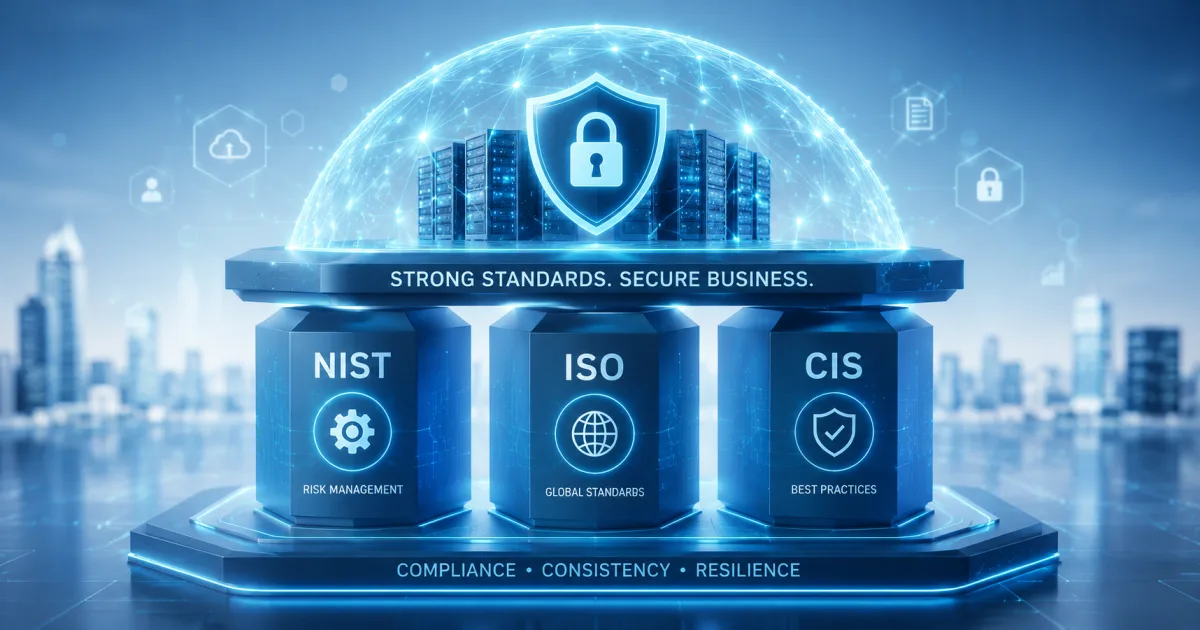
Cybersecurity Frameworks: Top Guide for SMBs | GoCo
Cybersecurity Frameworks help SMBs strengthen security with NIST, ISO 27001, and CIS Controls. Learn more today 🔐
Cybersecurity frameworks are like blueprints, they guide how your business protects its systems, data, and people. But if you’re a small business, you’ve probably asked yourself: “Which framework actually matters for us, and how do we even start implementing it?”
Between NIST, ISO 27001, SOC 2, HIPAA, and countless others, it’s easy to feel overwhelmed. Most of these were designed for enterprises with entire compliance departments, not for companies where the I.T. “team” might be a single overworked manager.
So, let’s cut through the noise.
This article breaks down the most relevant cybersecurity frameworks for small and mid-sized businesses (SMBs), how to choose the right one, and how to adopt best practices without needing a full-time compliance officer.
Here is the reason why Cybersecurity Frameworks Matter, Even for Small Teams
You do knowybercriminals no longer target only large corporations.
According to the 2024 Verizon Data Breach Investigations Report, over 60% of attacks affected SMBs. Why? Because smaller organizations often lack clear security structure.
Frameworks exist to fix that. They:
- Give you a structured roadmap — helping prioritize what matters most.
- Reduce guesswork — defining what “good security” looks like in practice.
- Prove credibility — partners and clients increasingly expect compliance proof.
- Prepare for audits — many frameworks align with regulatory requirements (like GDPR or SOC 2).
Think of a cybersecurity framework as your operational backbone: the difference between reacting to threats and building a system that prevents them.
Following Every Framework at Once is the most common mistake
Before diving in, here’s a warning. Many SMBs make the mistake of copying large-enterprise security models. The result?
- Endless documentation.
- Tools they don’t use.
- Burnout, without better protection.
Frameworks should scale to you, not the other way around.
The goal isn’t to be “certified in everything.” It’s to implement the right level of control for your current risk exposure, and scale as you grow.
The 5 Frameworks Every Small Business Should Know
Let’s break down the main cybersecurity frameworks, what they mean, and how they apply to SMBs.
1. NIST Cybersecurity Framework (CSF): The Practical Starting Point
Best for: Businesses of any size wanting a flexible, practical framework.
Developed by the U.S. National Institute of Standards and Technology, the NIST CSF is one of the most widely adopted cybersecurity frameworks globally, and the easiest for SMBs to start with.
It’s organized into five core functions:
- Identify — Know what you need to protect (assets, data, systems).
- Protect — Apply safeguards to keep threats out.
- Detect — Monitor continuously for anomalies.
- Respond — Have a plan when incidents happen.
- Recover — Restore operations quickly.
Why it works for SMBs:
- It’s not prescriptive — you choose controls that fit your size and budget.
- It scales easily as you grow.
- It’s recognized by regulators, insurers, and partners — building credibility fast.
At GoCo, we often recommend NIST CSF as the foundation of an SMB’s security roadmap.
2. ISO 27001: For Businesses That Need Global Recognition
Best for: SMBs managing sensitive data or working with enterprise clients.
The ISO 27001 standard (from the International Organization for Standardization) sets requirements for creating an Information Security Management System (ISMS) — a formal, auditable structure for managing data security.
Key strengths:
- Globally recognized and often a contractual requirement for enterprise vendors.
- Focuses on risk management and continuous improvement.
- Integrates with other ISO frameworks (like ISO 9001 for quality).
Challenges:
- Requires more documentation and auditing than NIST CSF.
- Certification can be expensive for small teams.
Our advice:
If your clients or partners demand compliance or you handle critical customer data — ISO 27001 is worth the investment. Otherwise, use it as an aspirational goal after mastering NIST CSF.
3. SOC 2: The Standard for Service Providers
Best for: Tech companies, SaaS providers, or MSPs handling customer data.
SOC 2 (Service Organization Control 2), developed by the American Institute of CPAs (AICPA), focuses on trust and transparency. It assesses how companies handle data under five trust principles:
- Security
- Availability
- Processing integrity
- Confidentiality
- Privacy
SOC 2 reports come in two types:
- Type I: Tests your design of controls (snapshot).
- Type II: Tests your controls over time (6–12 months).
For SMBs providing tech services or SaaS, SOC 2 compliance can be a major market differentiator, signaling reliability and maturity.
Pro tip: You don’t have to go for full certification. Start by aligning your practices with SOC 2 controls, it reduces future audit costs and strengthens trust.
4. CIS Controls: A Simplified Checklist for Fast Action
Best for: Companies wanting actionable steps with minimal overhead.
The Center for Internet Security (CIS) publishes a set of 18 security controls — essentially a prioritized cybersecurity to-do list.
Example controls:
- Inventory and control of enterprise assets.
- Secure configuration of hardware and software.
- Continuous vulnerability management.
- Email and web browser protections.
- Data recovery processes.
CIS Controls are highly tactical, meaning your I.T. or MSP partner can implement them right away.
If you’re overwhelmed by “frameworks,” start with CIS — it’s concrete, measurable, and maps directly to NIST CSF.
5. HIPAA, GDPR, and Other Industry-Specific Regulations
If you operate in regulated sectors, you may need to comply with specific data-protection laws.
Examples:
- HIPAA — for healthcare organizations managing patient data.
- GDPR — for businesses processing EU residents’ data.
- CCPA/CPRA — for California consumer data.
While these are legal mandates, not voluntary frameworks, they integrate well with NIST or ISO 27001 structures.
For small companies expanding internationally or managing personal data, combining a general framework (like NIST) with a legal one (like GDPR) ensures complete coverage.
4 Choosing the Right Framework for Your Business
So, which one should you adopt? Here’s a quick roadmap:
| Company Type | Recommended Framework | Why It Fits |
|---|---|---|
| Local business, < 50 employees | CIS Controls / NIST CSF (basic) | Fast wins, low cost, clear structure |
| Growing SMB (50–200 employees) | NIST CSF + SOC 2 alignment | Scalable, strong trust signal |
| Service-based business (SaaS, MSP, IT provider) | SOC 2 / ISO 27001 | Client-driven, demonstrates maturity |
| Regulated industries | NIST CSF + HIPAA/GDPR | Legal compliance |
| Expanding internationally | ISO 27001 | Global credibility |
The key is to start where you are and scale from there.
Cybersecurity frameworks are not one-size-fits-all, they’re building blocks.
How to Implement a Framework Without a Full I.T. Department
This is where many small businesses hesitate, they understand why frameworks matter but feel stuck on how to execute them.
Here’s how GoCo helps clients roll out structured cybersecurity in a manageable way:
- Assessment and gap analysis — Identify what’s missing using NIST CSF or CIS as a benchmark.
- Prioritize high-impact actions — Focus first on MFA, access control, and backups.
- Automate monitoring — Use endpoint management and SIEM tools to reduce manual work.
- Document simply — Keep a living spreadsheet of assets, users, and policies.
- Review quarterly — Frameworks are continuous processes, not one-time projects.
Pro tip: If your internal IT team is small, consider a Managed Service Provider (MSP) to maintain compliance hygiene. It’s often more cost-effective than hiring multiple specialists.
The Real ROI of Cybersecurity Frameworks
Some leaders still see cybersecurity as “overhead”. But here’s the real ROI:
| Benefit | Example |
|---|---|
| Reduced downtime | Framework controls prevent incidents that halt operations. |
| Lower insurance premiums | Cyber insurers reward structured security programs. |
| Faster sales cycles | Clients skip lengthy security questionnaires. |
| Improved trust | Investors and customers see you as a mature organization. |
In short, compliance frameworks save time, protect revenue, and open doors, especially when your business is scaling.
Common Pitfalls to Avoid
- Over-engineering too soon. Start simple; complexity grows with your business.
- Ignoring user training. 90% of incidents start with human error.
- Focusing only on tools. Frameworks are about process and people first.
- Never reviewing controls. Security changes monthly — frameworks must evolve.
The Future of Cybersecurity Frameworks for SMBs
AI-driven security, compliance automation, and continuous risk monitoring are reshaping how small businesses adopt frameworks.
Tools like AI-powered compliance platforms can now map your policies to NIST CSF or ISO 27001 automatically, reducing the manual load and improving audit readiness.
For growing companies, this means you can achieve enterprise-level protection without enterprise budgets**.**
Bringing It All Together
If there’s one takeaway, it’s this: You don’t need every cybersecurity framework. You just need the right one, implemented well.
Start with NIST CSF or CIS Controls to build a foundation.
As you grow, layer in SOC 2 or ISO 27001 to demonstrate maturity.
Always align your policies with your business goals, not just compliance checkboxes.
Let’s Build Security That Scales
At Good Company, we help businesses build smart, scalable cybersecurity strategies, aligning frameworks, tools, and culture for lasting protection.
Whether you’re aiming for compliance, resilience, or peace of mind, we’ll guide you every step of the way.
Let’s go ahead and assess your current cybersecurity posture to evaluate where to start.
You’re in Good Company.
Technology decisions shouldn't be based on trends; they should support better business outcomes.
Explore our latest LinkedIn articles, where we share practical insights on Managed IT Services, cybersecurity, governance, operational excellence, and the strategies helping businesses reduce risk and scale with confidence.
Because better decisions start with better understanding.
Good Company IT | GoCo
You are in Good Company