Cybersecurity Awareness Program: Top Guide for SMBs | GoCo
Start a cybersecurity awareness program that helps employees spot threats, report incidents, and strengthen your defenses. 🛡️ Learn more today.
Most businesses invest in cybersecurity tools hoping they’ll stop attacks before they happen. Firewalls, endpoint protection, email filters, backups—all essential. And yet, breaches still occur. Why? Because most cyber incidents don’t start with a technical failure.
They start with a human moment.
A rushed click.
A convincing email.
A reused password.
A well-timed message that feels just real enough.
Here’s the open loop we want to explore:
If modern cybersecurity tools are so advanced, why do attackers still succeed—and what are businesses missing?
The answer is simple, and uncomfortable: technology alone is not enough.
That’s where a cybersecurity awareness program becomes one of the most important, and most overlooked, parts of a company’s security strategy.
In this article, we’ll break down:
- What a cybersecurity awareness program really is
- Why every business needs one (regardless of size)
- How it reduces real-world risk
- What makes an effective program
- And how to start one without disrupting productivity
This isn’t about fear. It’s about building security that works in the real world.
- Cybersecurity Has a People Problem (Not Just a Technology Problem)
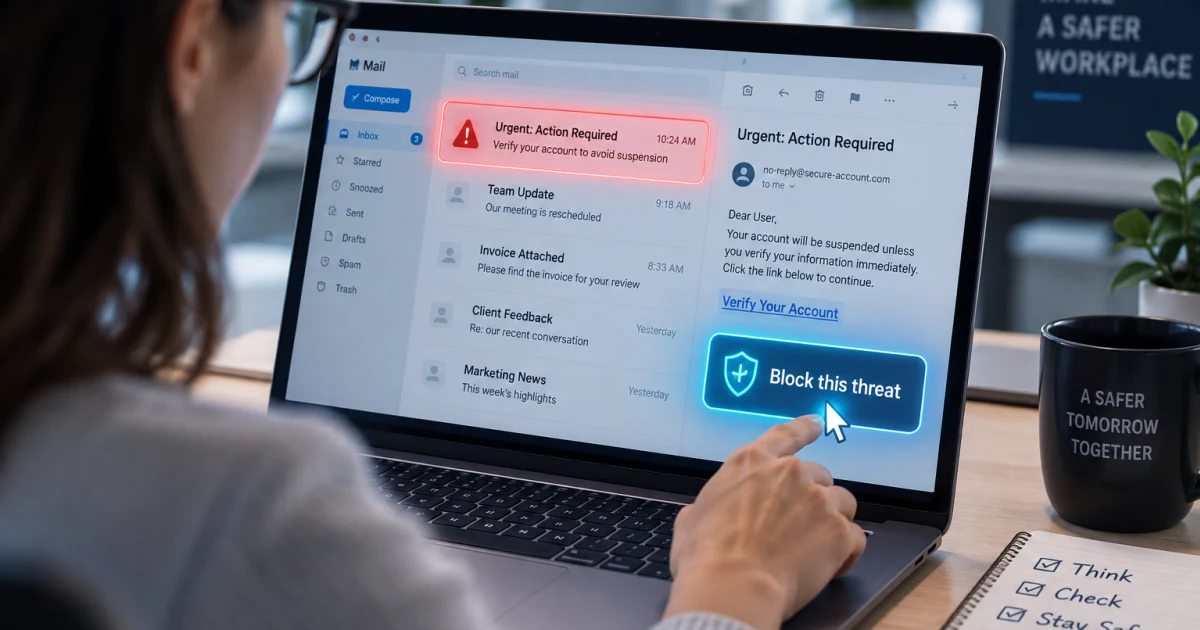
Modern attackers rarely “hack” systems in the traditional sense. Instead, they exploit something far more predictable than software vulnerabilities: human behavior.
Employees are asked to:
- Work fast
- Switch contexts constantly
- Respond to messages immediately
- Manage dozens of tools
- Make decisions under pressure
Attackers design their tactics around these realities.
Phishing, credential theft, social engineering, and impersonation attacks all rely on one assumption: people will eventually make a mistake.
And they’re right.
This doesn’t mean employees are careless. It means cybersecurity must account for how people work, not how policies assume they work.
A cybersecurity awareness program exists to close that gap between technology and human behavior.
2. What Is a Cybersecurity Awareness Program?
A cybersecurity awareness program is a structured, ongoing effort to help employees understand:
- Common cyber threats
- How those threats show up in daily work
- How to respond safely and consistently
It’s not a one-time training.
It’s not a long policy document no one reads.
And it’s not about turning employees into security experts.
At its core, a good awareness program helps people:
- Recognize risky situations
- Pause before acting
- Know what “safe” looks like
- Understand who to contact when something feels off
It turns employees into active participants in security, not passive risk factors.
3. Why Every Business Needs a Cybersecurity Awareness Program
1. Because Most Attacks Target People First
Phishing, business email compromise, fake login pages, impersonation—these attacks don’t break systems. They bypass them.
Security tools can block many threats, but no tool can:
- Decide whether an email “feels wrong”
- Recognize urgency manipulation
- Question a request that looks legitimate
Only people can do that.
A cybersecurity awareness program strengthens the one layer attackers rely on the most.
2. Because Security Tools Are Only as Effective as Their Users
Even the best security technology can be undermined by:
- Weak passwords
- Password reuse
- MFA fatigue attacks
- Unsafe file sharing
- Ignored security alerts
Awareness programs explain why controls exist, not just that they exist.
When employees understand the reasoning behind security measures, compliance improves naturally—without friction.
3. Because One Mistake Can Affect the Entire Organization
Cybersecurity incidents rarely stay isolated.
A single compromised account can lead to:
- Lateral movement across systems
- Data exposure
- Financial loss
- Operational downtime
- Compliance issues
- Reputational damage
Awareness training helps employees understand the impact of small actions, making security a shared responsibility.
4. Because Remote and Hybrid Work Expanded the Attack Surface
Work no longer happens inside a controlled office network.
Today’s workforce uses:
- Home Wi-Fi
- Personal devices
- Public networks
- Cloud-based tools
- Mobile access
This makes individual behavior even more important.
A cybersecurity awareness program helps teams adapt security habits to modern work environments.
5. Because Compliance and Client Trust Depend on It
Many frameworks and regulations (SOC 2, ISO 27001, HIPAA, GDPR) explicitly require:
- Security awareness training
- Documented policies
- Evidence of ongoing education
Beyond compliance, clients increasingly expect businesses to demonstrate security maturity—not just tools, but culture.
Awareness programs signal that security is taken seriously at every level.
4. What Happens Without Cybersecurity Awareness?
When awareness is missing, patterns emerge quickly:
- Employees hesitate to report suspicious activity
- Phishing attempts go unnoticed
- Credentials are reused across tools
- Offboarding gaps persist
- Shadow I.T. grows unchecked
- Security incidents are discovered too late
Most organizations don’t fail at security because they ignore it.
They fail because they assume technology will compensate for human behavior.
It won’t.
5. What Makes a Cybersecurity Awareness Program Effective?
Not all awareness programs work. In fact, many fail because they’re:
- Too technical
- Too generic
- Too infrequent
- Too disconnected from daily work
An effective program shares five characteristics:
1. It’s Ongoing, Not One-Time
Threats evolve. Tools change. People forget.
Good programs include:
- Short, regular training sessions
- Periodic refreshers
- Ongoing reminders
- Real-world examples
Security awareness is a habit, not an event.
2. It’s Practical and Role-Relevant
Employees don’t need theoretical knowledge. They need context.
Effective training covers:
- What phishing looks like in your tools
- How impersonation might target your roles
- What safe behavior looks like in your workflows
Relevance drives retention.
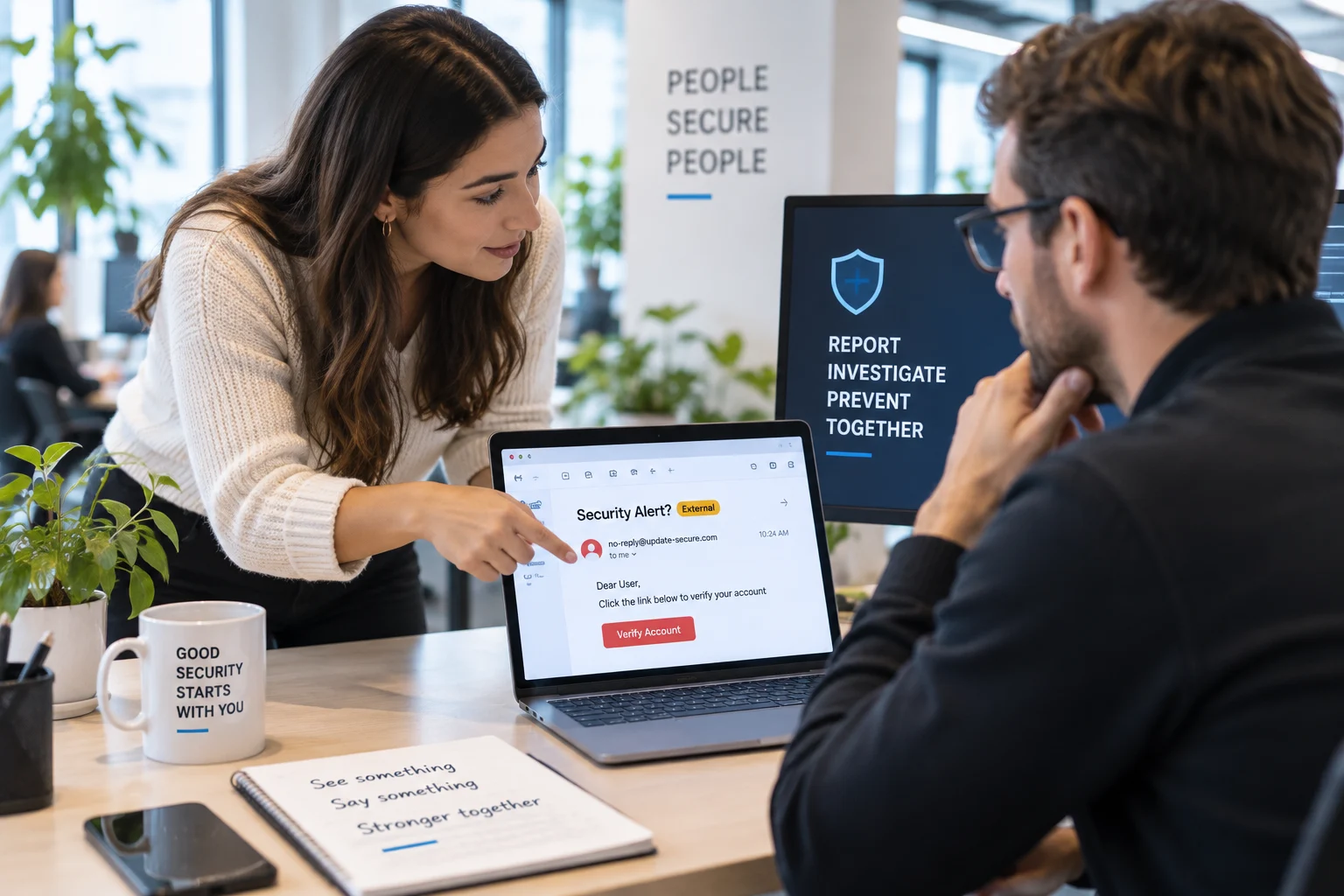
3. It Encourages Reporting, Not Blame
One of the biggest risks in cybersecurity is silence.
Employees should feel safe to:
- Report suspicious emails
- Ask questions
- Admit mistakes quickly
Awareness programs must reinforce:
Reporting early is always better than staying quiet.
Fast reporting limits damage.
4. It Works With Technology, Not Against It
Awareness should align with technical controls:
- MFA
- Email filtering
- Endpoint protection
- Access policies
Training explains how these tools help—and where human judgment still matters.
5. It’s Simple, Clear, and Repeatable
The goal isn’t to overwhelm people.
It’s to give them clear signals and clear actions.
For example:
- “Pause before clicking urgent requests.”
- “Verify changes to payment details.”
- “Never share credentials—no exceptions.”
Clarity reduces mistakes.
6. Common Cyber Threats Every Awareness Program Should Cover
A solid cybersecurity awareness program typically addresses:
Phishing and Social Engineering
- Email phishing
- SMS phishing (smishing)
- Voice phishing (vishing)
- Impersonation attacks
Credential Security
- Password hygiene
- MFA usage
- Credential reuse risks
Device and Remote Work Security
- Secure Wi-Fi usage
- Device locking
- Public network risks
Data Handling
- Sensitive data identification
- Secure sharing
- Cloud storage best practices
Incident Reporting
- What to report
- How to report
- When to escalate
Coverage should evolve as threats change.
7. How to Start a Cybersecurity Awareness Program (Step by Step)
Starting doesn’t require a massive budget or months of planning. It requires structure.
Step 1: Assess Your Current Risk
Ask:
- Have we experienced phishing attempts?
- Do employees know how to report incidents?
- Is MFA enforced everywhere?
- Are policies clear and accessible?
This helps tailor the program.
Step 2: Define Clear Goals
Examples:
- Reduce successful phishing clicks
- Increase reporting speed
- Improve password hygiene
- Support compliance requirements
Clear goals guide content and measurement.
Step 3: Choose the Right Format
Effective programs use a mix of:
- Short training modules
- Simulated phishing exercises
- Policy refreshers
- Real incident examples
Short and frequent beats long and rare.
Step 4: Align With Your I.T. and Security Controls
Training should reflect:
- Your tools
- Your access model
- Your workflows
Generic advice feels disconnected. Customized guidance sticks.
Step 5: Communicate Expectations Clearly
Employees should know:
- What’s expected of them
- Where to go with questions
- How incidents are handled
Transparency builds trust.
Step 6: Measure and Improve
Track:
- Reporting rates
- Incident response times
- Common mistakes
- Engagement levels
Awareness programs improve through iteration.
8. Cybersecurity Awareness as a Business Advantage
Beyond risk reduction, awareness programs create tangible business benefits:
- Faster incident detection
- Reduced downtime
- Stronger client trust
- Improved compliance readiness
- Higher employee confidence
- Lower long-term security costs
Security becomes part of how the business operates—not an obstacle to productivity.
9. How GoCo Helps Businesses Build Real Cybersecurity Awareness
At GoCo, we believe awareness is not about fear—it’s about empowerment.
We help businesses:
- Design awareness programs aligned with real workflows
- Integrate training with I.T. and security controls
- Build reporting cultures, not blame cultures
- Support compliance and operational maturity
Security works best when people and technology work together.
Conclusion: Cybersecurity Awareness Is No Longer Optional
Every business relies on technology.
Every technology relies on people.
That makes cybersecurity awareness a foundational requirement, not an extra.
The strongest defenses combine:
- Smart technology
- Clear processes
- Informed, confident teams
If your business hasn’t invested in awareness yet, the best time to start is now, not after an incident forces the lesson.
Cybersecurity doesn’t start with tools.
It starts with understanding.
Remember that when awareness becomes part of your culture, security becomes sustainable.
Technology decisions shouldn't be based on trends; they should support better business outcomes.
Explore our latest LinkedIn articles, where we share practical insights on Managed IT Services, cybersecurity, governance, operational excellence, and the strategies that help businesses reduce risk and scale with confidence.
Because better decisions start with better understanding.
Good Company IT
GoCo
You are in Good Company