AI-Driven Phishing: Best Practices | Good Company
Stop AI-driven phishing with smarter cybersecurity and phishing protection. Learn how to defend your business today. Learn more 🛡️💻
Picture this: You open your inbox on a busy Monday morning. There’s an email from your “finance director” asking you to review an invoice, something you do every week. The tone feels right. The signature looks real. The grammar? Perfect. You click. And just like that, your credentials and your company data are in the hands of a hacker using AI-generated phishing tactics that mimic real people better than ever before.
This isn’t the “Nigerian prince” scam your spam filter catches. This is a new generation of phishing powered by artificial intelligence, faster, more personalized, and nearly impossible to spot with the naked eye.
So, the question is: how do you protect your business when the attacks are smarter than ever?
Let’s break it down.
What Is AI-Driven Phishing?
Phishing is the practice of tricking users into revealing sensitive information—passwords, financial data, or access credentials—through deceptive communication (usually email).
Traditionally, these attacks were easy to spot: poor grammar, odd email domains, or generic messages sent in bulk.
But AI has changed the game.
AI-driven phishing uses machine learning, natural language processing (NLP), and automation to:
- Craft hyper-personalized emails using public and breached data.
- Mimic the tone, writing style, and even email signatures of trusted contacts.
- Send large volumes of unique, believable messages automatically.
Think of it as phishing 2.0, targeted spear-phishing on autopilot.
The Rise of AI in Cybercrime
Hackers have always followed technology trends, and AI is no exception.
Tools like ChatGPT, deep learning text generators, and voice synthesis have made it incredibly easy to replicate legitimate communication patterns.
According to multiple cybersecurity reports, phishing remains the #1 cause of data breaches worldwide, and AI is accelerating its success rate.
Why?
Because AI allows attackers to:
- Analyze and imitate company communication styles
- Create realistic language models
- Automate and scale
The barrier to entry for sophisticated phishing has never been lower.
Why AI Makes Phishing So Effective
Traditional security filters were built to catch pattern-based threats—known malicious domains, suspicious attachments, or common spam phrases.
AI-driven phishing, however, breaks those patterns.
Here’s how:
Hyper-Personalization: Attackers now have access to huge data sets—social media, company websites, breach databases.
AI uses that data to generate emails that sound like they came directly from your CEO or a client you trust.
-
Language Precision: Machine learning models trained on legitimate communication can generate text that perfectly mimics professional tone and syntax, making detection difficult.
-
Voice and Video Deepfakes: With AI voice cloning and deepfake tools, phishing isn’t just limited to emails. Hackers can leave voicemails, conduct fake video calls, or even impersonate executives in live meetings.
-
Real-Time Adaptation: AI systems can analyze failed attempts and adjust instantly. If a phishing email doesn’t get past a spam filter, the system tweaks the content until it does.
-
Scale and Speed: What once took weeks for hackers to research and write can now be done in seconds, and thousands of personalized attacks are launched automatically.
Real-World Scenarios: How AI Phishing Works
Let’s make it real.
Case 1: The “Invoice” Trap
A cybercriminal scrapes your finance team’s email patterns and past invoices from a breached mailbox. Using AI, they craft a new invoice request with perfect formatting and tone.
You click the link to “review,” and it downloads a malicious script that captures your credentials.
Case 2: The “Voice of Your CEO”
Using samples from a public webinar, hackers generate a synthetic voice message asking your HR team to “urgently process a payment.” The message sounds authentic—and because it’s AI-generated, it bypasses standard fraud filters.
Case 3: Chat-Based Phishing (AI Chatbots)
Phishing bots posing as customer support agents engage with your employees via Slack or Teams, gradually convincing them to share credentials or MFA codes.
Each of these tactics uses AI to mimic trust—the one element every business relies on.
The Technical Side: Why Traditional Security Fails
Many businesses still rely on basic security controls: spam filters, antivirus tools, and firewall protection. While these are necessary, they’re no longer enough.
AI-driven phishing doesn’t just rely on malicious links, it manipulates context and behavior.
- It uses legitimate domains (compromised accounts).
- It leverages AI-generated text that avoids spam trigger words.
- It sends attachments disguised as routine files (.pdf, .xls, .docx) that are clean until opened.
Traditional tools can’t detect intent—they only detect signatures.
That’s where modern Zero-Trust and behavioral security frameworks come in.
The AI Arms Race: Security Tools Fighting Back
Luckily, AI isn’t only in the attackers’ toolbox.
Cybersecurity teams now use defensive AI to detect phishing in real time. Here’s how modern IT security is evolving to counter AI phishing:
1. Behavioral Analysis: AI-driven security tools (like EDR and SIEM systems) monitor user behavior patterns, who logs in, from where, at what time, and what they access.
If an anomaly appears, the system flags or blocks access automatically.
2. Natural Language Processing (NLP) Detection: Security platforms are now trained to understand the linguistic nuances of phishing messages—tone, urgency, structure—and can detect subtle manipulation patterns even in grammatically correct emails.
3. Identity and Access Management (IAM): By enforcing multi-factor authentication (MFA) and least-privilege access, Zero-Trust environments limit what damage can be done if a phishing attack succeeds.
4. DNS and Email Authentication (SPF, DKIM, DMARC): AI phishing often spoofs domains. Email authentication protocols ensure every message truly originates from the sender’s domain—stopping impersonation at the source.
5. Automated Threat Response: With Security Orchestration, Automation, and Response (SOAR) tools, suspicious emails can be quarantined and analyzed without human intervention, drastically reducing risk exposure.
Why SMBs Are at Greater Risk
Small and mid-sized businesses (SMBs) are often the prime targets of AI phishing for one reason: limited resources.
Many don’t have full-time IT security staff, let alone advanced AI defense tools.
Attackers know this—and they exploit it.
Some common challenges SMBs face:
- Overworked teams responding to dozens of “urgent” emails daily
- Lack of phishing simulation training
- No centralized visibility over all communication channels
- Using multiple unmanaged SaaS platforms
The result? A perfect storm for AI phishing success.
Building Your Anti-Phishing Defense: Step by Step
It’s not enough to install a security tool; you need a layered defense combining people, process, and technology.
Step 1: Build a Human Firewall
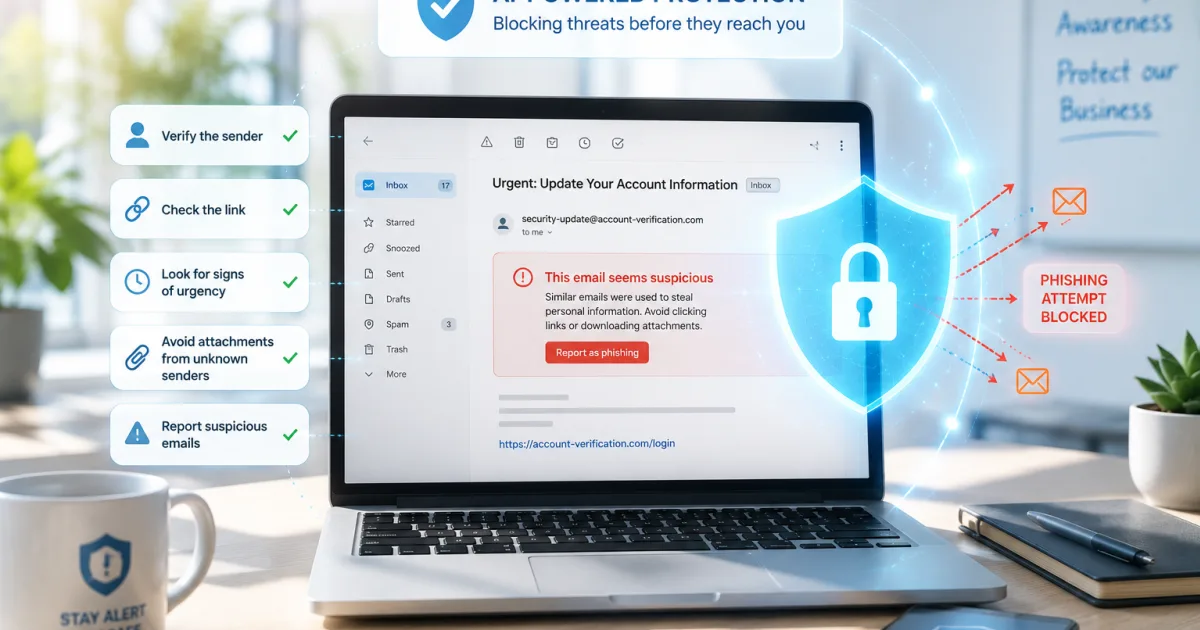
Train your employees to identify red flags:
- Unexpected requests for credentials or payment
- Slightly altered email domains (e.g., g00gle.com)
- Unusual urgency or emotional language
Run phishing simulations regularly. Awareness is still your first line of defense.
Step 2: Implement Zero-Trust Architecture
Assume every request could be malicious.
Use continuous verification and segment internal networks.
Even if one account is compromised, Zero-Trust prevents it from spreading laterally.
Step 3: Strengthen Email Authentication
Activate SPF, DKIM, and DMARC for your domains.
These ensure messages can’t be easily spoofed.
Step 4: Enforce MFA and Password Hygiene
MFA stops over 99% of credential-based attacks.
Combine it with password managers to enforce complexity without hurting productivity.
Step 5: Leverage AI-Powered Security Solutions
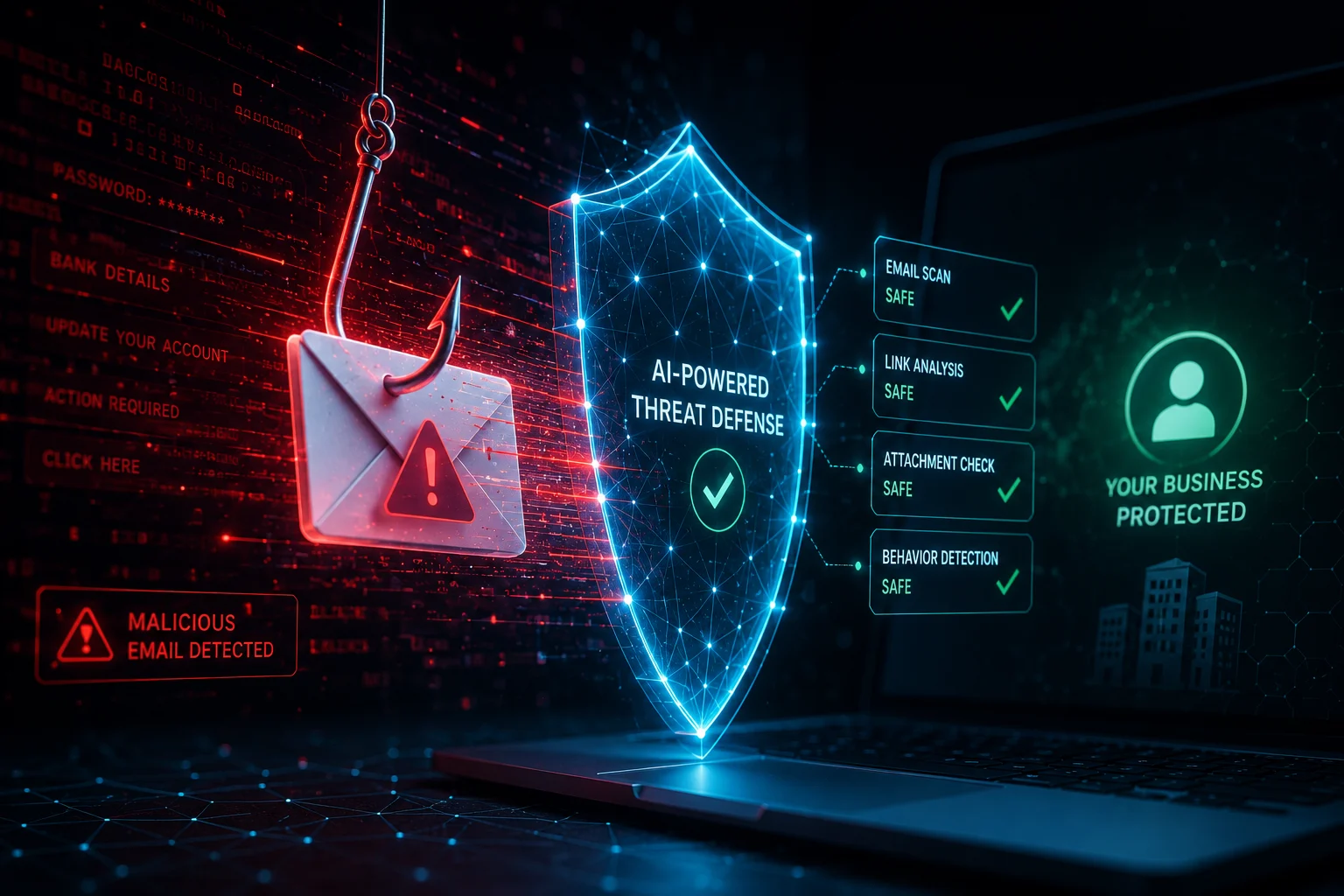
Adopt endpoint and email protection platforms that use AI to detect contextual phishing patterns, not just keywords.
Step 6: Partner With an MSP or Cybersecurity Team
Outsourcing IT security gives SMBs access to enterprise-grade tools, compliance expertise, and 24/7 monitoring—without the cost of a full in-house team.
The Compliance Angle: Phishing and Regulatory Risk
For regulated industries (finance, healthcare, legal), phishing isn’t just a security threat; it’s a compliance violation waiting to happen**.**
Under frameworks like SOC 2, HIPAA, and ISO 27001, organizations are required to demonstrate data integrity and access control.
A successful phishing attack often results in:
- Unauthorized data access
- Breach of confidentiality agreements
- Fines or loss of certification
Implementing AI-aware phishing defenses directly supports compliance goals.
The Business Case for Anti-Phishing Investment
You can’t measure cybersecurity ROI like marketing spend—but you can calculate the cost of a breach.
Consider this:
- The average cost of a phishing-related breach for SMBs now exceeds $130,000**.**
- 60% of affected businesses shut down within six months of a major cyberattack.
Investing in proactive security, AI-driven detection, training, and MSP support—isn’t an expense.
It’s an insurance policy for continuity and trust.
Future Trends: Where AI Phishing Is Headed
We’re only at the beginning of this transformation. Expect the next wave to include:
- AI-powered chat phishing integrated into messaging apps.
- Synthetic identities combining real and fake data to evade detection.
- Context-aware attacks that exploit specific company events (like funding rounds or product launches).
As attackers get smarter, defenses must evolve—not react.
Phishing Is Evolving, So Should You
AI-driven phishing isn’t a future risk—it’s happening now.
Your employees are the new perimeter.
Your data is the new currency.
And trust, digital trust, is the new security.
Building an AI-resilient security framework isn’t optional; it’s the foundation of doing business in 2025**.**
Ready to strengthen your defenses?
GoCo helps SMBs implement intelligent security measures that prevent, detect, and respond to phishing attacks before damage is done.
Let’s protect your people, your data, and your reputation.
Talk to a GoCo cybersecurity expert today.
Explore our latest LinkedIn articles, where we share practical insights on Managed IT Services, cybersecurity, governance, operational excellence, and the strategies helping businesses reduce risk and scale with confidence.
Because better decisions start with better understanding.
Good Company IT
GoCo
You are in Good Company